

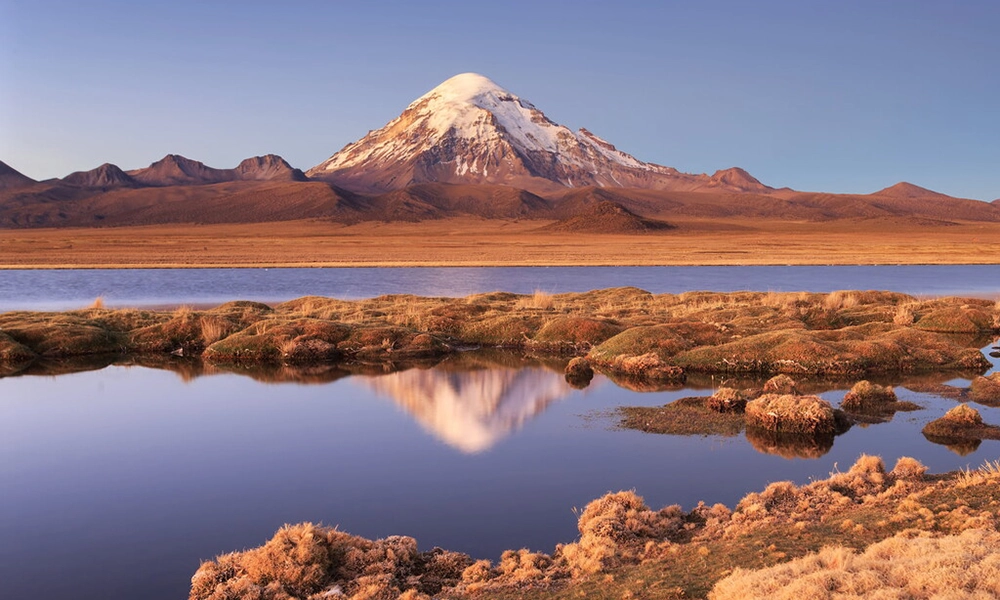
Sajama Mountain: The Sacred Giant of the Bolivian Altiplano
Sajama Mountain is much more than just the highest mountain in Bolivia. It is a natural, spiritual, and cultural symbol of the Altiplano, a solitary colossus that dominates the landscape with an imposing and silent presence. Its conical silhouette, covered in snow for much of the year, rises above endless plains, verdant wetlands, and skies of indescribable purity.
Located within Sajama National Park, in the far west of the country, Sajama reaches 6,542 meters above sea level, making it the highest point in Bolivia and one of the most emblematic volcanoes in South America. Its surroundings are as powerful as the mountain itself: vast, silent, and ancient.
A landscape where time seems to stand still
Visiting Sajama is like stepping into the heart of the Altiplano, where the horizon disappears and the sky seems closer. Here there are no big cities or modern noise: only wind, light, mountains, and Andean life that follows its ancestral rhythm.
Sajama is an extinct stratovolcano, and although its volcanic activity ended thousands of years ago, the energy of the subsoil remains present in the form of hot springs and geysers, reminding us that the earth beneath our feet is still alive.
Sajama National Park: Much More Than a Mountain
The park, created to protect this unique ecosystem, is one of the most important natural areas in Bolivia. It not only safeguards Nevado Sajama, but also other volcanoes and landscapes of great ecological and cultural value.
🌿 Queñua Forests: Trees That Defy the Altitude
One of the park’s greatest treasures is the queñua forest, considered the highest forests in the world. These twisted trees, with their reddish bark, grow at over 4,500 meters and play a vital role in protecting the soil and Andean biodiversity.
🦙 Wildlife of the Andean Highlands
On the plains and wetlands, it is common to see:
- Vicuñas, a symbol of Andean elegance
- Llamas and alpacas, closely linked to the lives of the communities
- Suris (birds similar to rheas)
- Vizcachas among volcanic rocks
With luck, you might also spot Andean condors soaring above Sajama.
Sajama and the Andean Cosmovision
For the local communities, Sajama is not just a mountain: it is an Apu, a protective deity. In the Andean cosmovision, the Apus watch over the land, water, and life. Therefore, respect for the mountain is profound and is manifested in rituals, offerings, and traditions that are still preserved.
Walking on Sajama is also walking on a sacred space, where nature and spirituality intertwine.
What to do in and around Nevado Sajama
🚶♂️ Hiking and scenic exploration
You don’t need to be a mountaineer to enjoy Sajama. There are easy hikes and scenic trails ideal for:
- observing the mountain from different angles,
- exploring wetlands and plains,
- enjoying the absolute silence of the high plateau.
♨️ Outdoor hot springs
One of the park’s greatest pleasures is soaking in natural hot springs, with Sajama and other volcanoes as a backdrop. The experience of warm water amidst the chill of the high plateau is simply unforgettable.
📸 Nature photography
Sajama is a photographer’s paradise:
- sunrises with golden light on the volcano,
- starry night skies without light pollution,
- contrasts between snow, grasslands, and intense blue skies.
🧗♂️ Ascent of Nevado Sajama
The ascent to the summit is a high-altitude activity, reserved for experienced climbers with excellent acclimatization and the support of specialized guides. It is not an extreme technical climb, but the altitude, the cold, and the glaciers make it a serious challenge that is usually undertaken over several days, with intermediate camps.
Climate and Best Time to Visit
The Altiplano has a cold and dry climate, with significant temperature differences between day and night.
- Best time: May to September, during the dry season, when skies are usually clear and the views are at their best.
- Wet season: November to March, with more clouds and occasional rain, although the landscape becomes greener.
Temperatures can be pleasant during the day with sunshine, but drop sharply at sunset and at night.
How to get to Nevado Sajama
The most common way to get there is from La Paz or Oruro, combining ground transportation to the park area with local transfers. Many people opt for organized tours due to the distances, altitude, and logistics involved.
Essential recommendations for your visit
- Acclimate well: Spend at least one or two days at altitude before exploring Sajama.
- Wear layers: The weather changes quickly.
- Protect yourself from the sun: The radiation at the Altiplano is very intense.
- Respect the local culture: You are in sacred territory for the communities.
- Plan your time: Distances may seem short, but the pace of life at altitude is slower.
Frequently Asked Questions about Nevado Sajama
Is Nevado Sajama the highest point in Bolivia?
Yes, at 6,542 meters above sea level, it is the highest mountain in the country.
Can it be visited without climbing to the summit?
Absolutely. Most visitors come for the scenery, hot springs, wildlife, and easy hikes.
Is it very cold?
Yes, especially at night and in the early morning. During the day, the sun can make the temperature more bearable.
Is it a mass tourist destination?
No. Sajama remains a peaceful and relatively uncrowded destination, ideal for those seeking authentic nature.
Is it worth staying more than one day?
Yes. Sleeping in the area allows you to enjoy sunrises, night skies, and the true rhythm of the Altiplano.
Sajama: an experience to be felt, not just visited
Nevado Sajama doesn’t impress with excess, but with depth. Its silence, its size, and its energy make the traveler feel small, yet connected. It is a place to observe, breathe, listen to the wind, and understand that nature, when immense, can also be profoundly serene.