

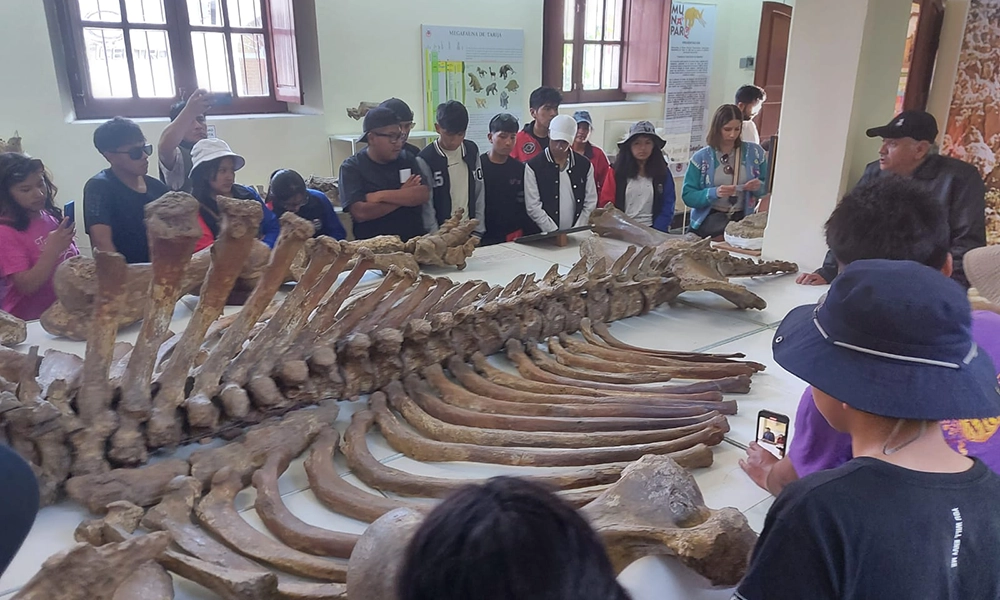
Tarija National Paleontological Archaeological Museum (MUNAPARQ)
The Tarija National Paleontological Archaeological Museum (MUNAPARQ) is, without exaggeration, one of the most impressive museums to visit in southern Bolivia if you enjoy history, science, or simply want to see something unexpected in a city of valleys and wineries: real fossils of prehistoric “giants” and a collection that transports you to a Tarija where enormous mammals like the Megatherium (giant sloth), Glyptodonts (giant armored armadillos), Mastodons, and the famous Smilodon (saber-toothed cat) roamed.
At the institutional level, MUNAPARQ is part of the Juan Misael Saracho Autonomous University (UAJMS). It was inaugurated in 1959 and officially elevated to the status of “National Museum” in 1994 by Law No. 1553.
📍 Exact Location and Easy Directions
The museum is one block from Plaza Luis de Fuentes (the main square), making it perfect for travelers: you can easily walk there if you’re staying downtown.
Reference address: Calle Gral. Trigo 402, corner of Virginio Lema.
🚖 How to Get There (Easy)
- On foot: If you’re staying near the main square, you’ll get there quickly.
- By taxi: Ask for “Museo Paleontológico / MUNAPARQ – Calle Gral. Trigo and Virginio Lema” and you’ll be taken there right away.
🕒 Opening Hours and Admission Prices (for better planning)
Opening Hours (local tourist reference)
-
Monday to Friday:
- Morning 8:30–12:30 (last entry 12:00)
- Afternoon 3:00–6:30 (last entry 6:00)
- Saturday and Sunday: 8:30–12:30 (last entry 12:00)
Admission
- Children and students: 2 Bs
- Adults: 5 Bs
- Foreigners: 20 Bs
📌 Traveler’s tip: If your schedule is tight, visit in the morning (fewer people, more time, and better light for photos).
🧠 Why is this museum so important in Tarija?
Tarija is not just about wine and landscapes: it is also one of Bolivia’s most renowned destinations for its paleontological discoveries. Many of the discoveries have been made even in areas that are now urbanized (for example, the Catedral neighborhood is mentioned as emblematic for the discovery of glyptodonts and other remains).
This makes the museum special for two reasons:
- You don’t just see “pretty replicas”: you’re looking at the real history of the valley.
- You understand the territory: why Tarija is a valley with sedimentary layers that preserved fossils for thousands of years.
🏛️ A little bit of MUNAPARQ history (to enhance your visit)
- It was inaugurated in 1959 (there are even references that specify April 15th as the official opening date).
- In 1994, Law No. 1553 elevated it to the status of a National Museum and mandated the development of a paleontological, archaeological, and anthropological research program in the Tarija Valley.
- The museum is affiliated with the UAJMS (Autonomous University of Juan Misael Medellín) and its mission focuses on preserving, researching, and disseminating Tarija’s paleontological and archaeological heritage.
🦣 What to see at the museum: galleries and collections
MUNAPARQ is organized as a “mixed” museum (paleo + archaeology + geology). Its website displays a menu of collections that includes paleontology (vertebrates, invertebrates, paleobotany), archaeology, and rocks/minerals.
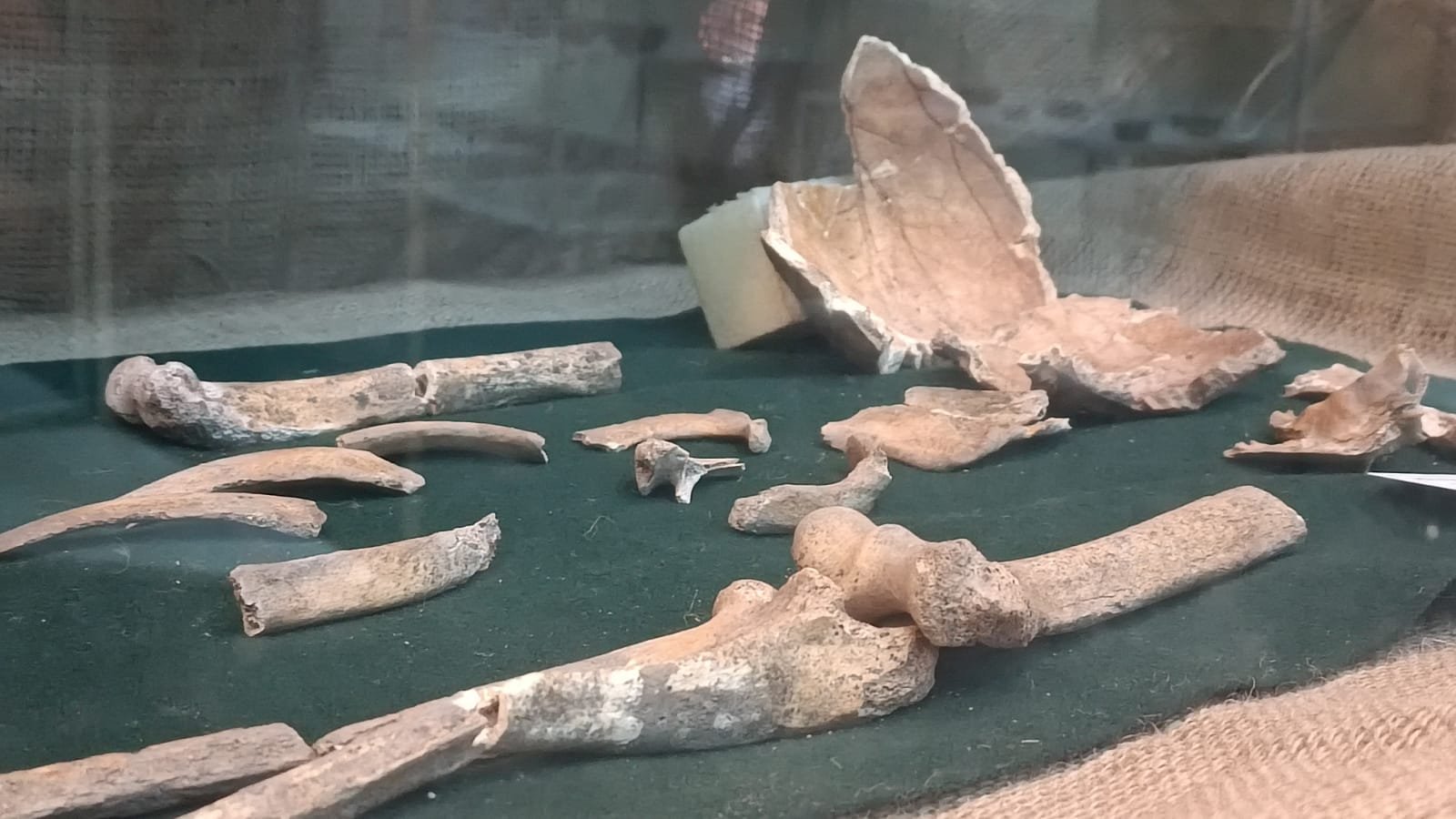
🦴 1) Megafauna Hall (the most popular with tourists)
Here’s what will leave you speechless: enormous animals from South American megafauna, such as:
- Megatherium (giant sloth)
- Glyptodonts (giant armored armadillos)
- Mastodon (relative of elephants)
- Smilodon (saber-toothed cat)
- And others like Palaeolama and Macrauchenia, which help you imagine what the ecosystem was like.
How to fully enjoy this hall (without being an expert):
- First, look at the skeletons as a group to grasp their size and shape.
- Then, get closer to the skulls, teeth, plates, and long bones: that’s where you understand the animal’s power.
- Consider the mental comparison: “How would this move in a valley like Tarija?”
🏺 2) Archaeology and Human Presence
After the initial awe-inspiring sight of the giants, archaeology brings you back down to earth: humans, material culture, and the land itself. While visitors sometimes come solely for the fossils, this section is invaluable because it helps you understand Tarija in layers: first, ancient nature, then human occupation.
🪨 3) Rocks and Minerals (the foundation of the Tarija landscape)
This section may seem less touristy, but it explains why fossils exist here: strata, sediments, rock types, and minerals. If you enjoy understanding the destination (not just looking at it), this room provides real context.
🧭 Recommended route within the museum (to make the most of your time)
Ideal route (1.5 to 2 hours):
- Megafauna (impact + photos)
- Archaeology (cultural context)
- Rocks and minerals (explanatory closing)
Quick route (45 to 60 min):
- Megafauna + a brief visit to the other sections.
⏱️ How much time should you spend? (depending on your travel style)
- 45–60 min: if you’re in a hurry and want the essentials (megafauna).
- 1.5–2 hours: recommended for most (see everything at a leisurely pace).
- 2–3 hours: if you read calmly, take photos, ask questions, and enjoy learning.
Traveler reviews mention that the space can feel small and that “one hour is enough,” but also that there is a guide.
(In practice: if you go with curiosity, you’ll easily stay for more than an hour.)
🎒 Practical travel tips (the ones that actually help)
✅ Before entering
- Bring small bills for the entrance fee.
- If you’re going on a Saturday or Sunday, arrive early (it’s only open in the morning).
During the visit
- Ask if a guide or explanation is available: it greatly improves the experience.
- Don’t just go “for photos”: the value lies in reading at least the basics about the main exhibits.
✅ If you’re traveling with children
- Make it fun: “find the biggest tooth,” “find the strangest animal,” “who was stronger: the megatherium or the mastodon?”
- Bring water and a light snack for afterward (the museum is best enjoyed on a full stomach).
📸 What photos to take (and how to take the best ones)
- Photos of complete skeletons for scale (with you next to them).
- Close-up of tusks/teeth/skulls (these are the most impressive).
- Details of plates (glyptodonts) or claws/long bones (megatherium).
- If there are display cases, take photos without a strong flash (natural light is best).
🧩 How to combine MUNAPARQ in your Tarija itinerary
🗺️ Option A: “Cultural Morning + Relaxing Afternoon”
- 9:30 AM Museum (1.5–2 hours)
- 12:00 PM Main Square and city center (one block away)
- 1:00 PM Lunch
- Afternoon: Waterfront / cafes / wineries
🍷 Option B: “Museum + Wine Route”
- Morning: Museum (opens your mind with natural history)
- Afternoon: Winery and tasting (end with the best of modern Tarija)
❓ Frequently Asked Questions (traveler’s version)
Is it recommended if I’m not interested in “science”?
Yes. Because the megafauna is visually stunning and impactful; you don’t need to be an expert to enjoy it.
Is it near the city center?
Yes, one block from the main square and with a clear route to the city center.
How long does it take to see everything?
1.5 to 2 hours is plenty. If you only want to see the highlights, 1 hour is enough.
Why does Tarija have so many fossils?
Because many finds are associated with strata in the valley (and several were found in areas that are now urbanized, like the Catedral neighborhood), which reflects the paleontological richness of the region.
🦴 Closing: Why this museum is a “must-see”
MUNAPARQ shows you a Tarija that almost no one imagines at first glance: a valley where, before wineries and plazas, there were giants and a vast natural history preserved underground. It’s a short, centrally located, and very powerful visit: you leave with photos, yes, but above all with the feeling of having understood Tarija from a different perspective.