

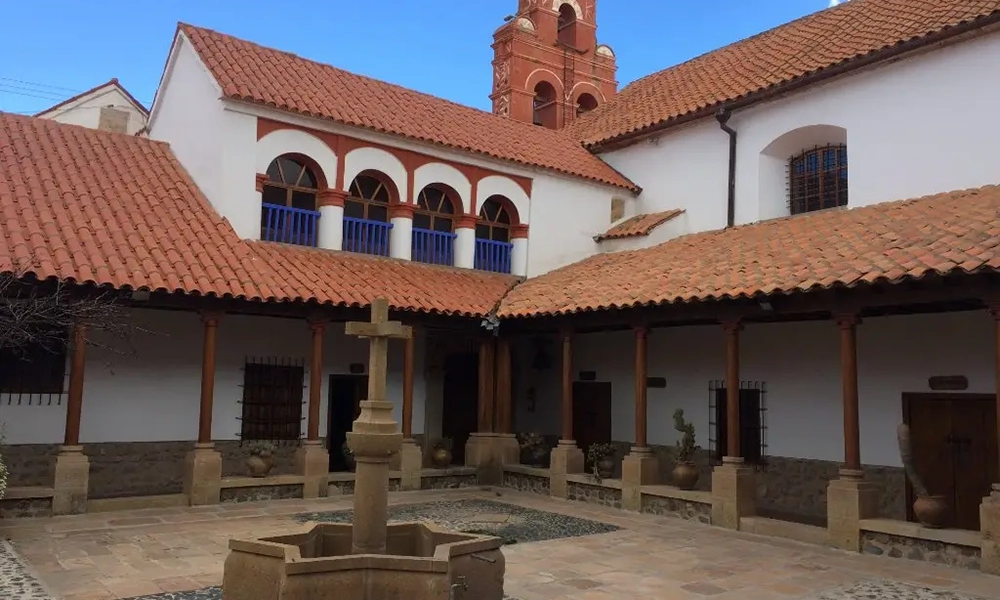
Convent of San Francisco de Asís
Deep History, Franciscan Architecture, Colonial Art, and Heritage Value
The Convent of San Francisco de Asís in Potosí is one of the oldest and most significant religious complexes in the city and a key piece for understanding the spiritual, social, and urban history of colonial Potosí. Unlike other churches directly associated with mining wealth, San Francisco de Asís represents austerity, social assistance, and community life—values deeply linked to the Franciscan order.
This convent was not only a place of prayer but also a refuge, a center of learning, and a source of spiritual guidance in one of the richest—and at the same time, harshest—cities of the colonial world.
📍 Location and Historical Urban Context
The convent is located within the historic center of Potosí, in an area that experienced rapid urban growth following the discovery of Cerro Rico in 1545. During this period, the city attracted thousands of people: miners, merchants, artisans, religious figures, and Indigenous people relocated by the colonial system.
The location of the San Francisco Convent allowed the friars to be close to the working class, fulfilling a direct pastoral mission in neighborhoods inhabited by miners and humble families, far removed from the city’s more elite circles.
🕰️ Foundation and Historical Development of the Convent
The Franciscan presence in Potosí dates back to the 16th century, when the order arrived to address the spiritual needs of a rapidly growing population. The convent gradually became one of the city’s first stable religious centers.
Throughout the colonial period, the convent underwent several stages:
- Initial construction using local materials
- Expansions to accommodate more religious personnel
- Architectural adaptations following earthquakes and the passage of time
- Partial changes in function during the republican era
Despite these transformations, the complex has retained its Franciscan essence and its role as an active religious space.
🤲 The Franciscan Order in Potosí: Mission and Values
The Franciscans were characterized by an evangelization based on simplicity, example, and closeness to the local population. In Potosí, their work was especially relevant due to the harsh living conditions associated with mining.
Main functions of the convent:
- Evangelization of Indigenous and mixed-race people
- Spiritual assistance to miners and their families
- Care for the sick and vulnerable
- Basic religious formation
- Support during times of social crisis
This approach made the convent a point of spiritual equilibrium in a city marked by inequality and constant risk.
⛪ Architecture of the Convent of San Francisco de Asís
The architecture of the complex reflects the Franciscan principles of austerity and functionality, moving away from the excessive luxury found in other colonial churches in Potosí.
General architectural characteristics:
- Predominant use of stone and adobe
- Thick, sober, and sturdy walls
- Functional floor plan oriented towards community life
- Spacious areas without excessive ornamentation
This architecture does not seek to impress visually, but rather to serve prayer, community life, and religious work.
🏛️ The church: a space for reflection and faith
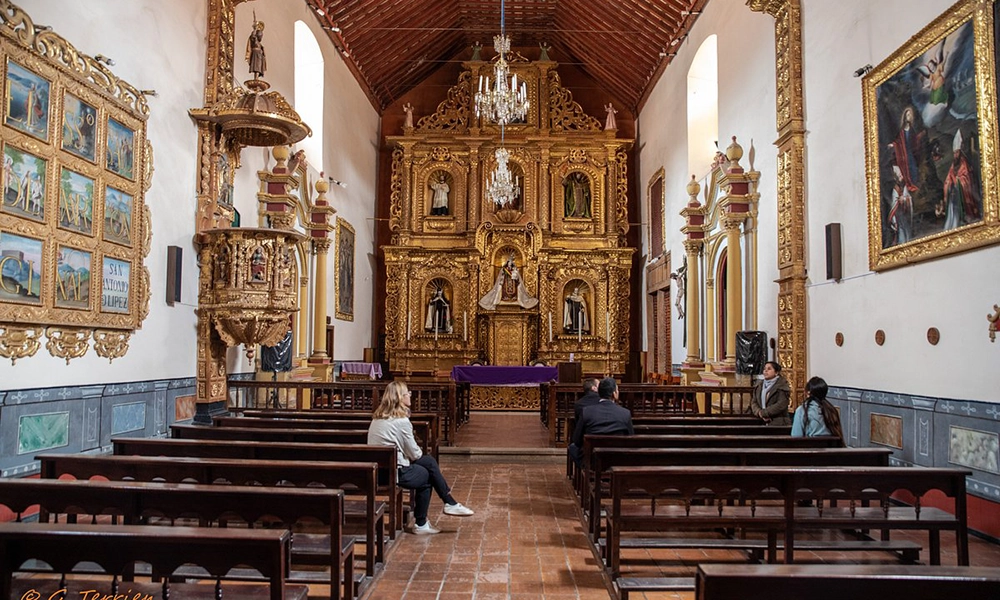
The convent church constitutes the spiritual heart of the complex. Its design is simple and conveys a sense of silence and contemplation.
Inside, the following are preserved:
- Simple colonial altarpieces
- Images of Saint Francis of Assisi and other Franciscan saints
- Religious paintings from the colonial era
- Antique liturgical objects
The decoration serves a pedagogical and spiritual function, prioritizing the religious message over ornamentation.
🌿 The convent cloisters and daily life
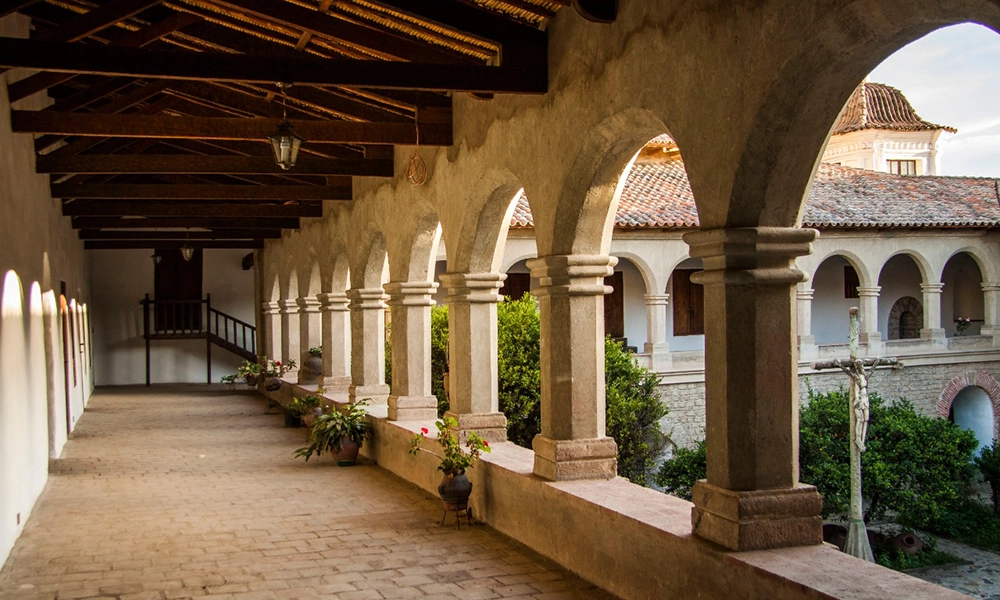
The convent cloisters were conceived as spaces for community life and reflection. Around interior courtyards were organized:
- Friars’ cells
- Areas for study and prayer
- Work and rest areas
These cloisters represented a refuge of calm from the hustle and bustle and harshness of the mining town, allowing for a disciplined and contemplative life.
🎨 Religious Art and Cultural Heritage
Although the convent is not known for its exuberant ornamentation, it preserves a valuable artistic heritage that reflects Franciscan spirituality and the colonial Andean context.
Among the most important elements are:
- Devotional wooden sculptures
- Colonial paintings with Christian themes
- Traditional architectural details
- Historical liturgical objects
These pieces allow us to understand how Christianity adapted to the cultural and social reality of Potosí.
🧭 Historical and Heritage Significance
The Convent of San Francisco de Asís is part of the historic center of Potosí, a city declared a World Heritage Site. Its heritage value lies in:
- Its antiquity
- Its social role during the colonial period
- Its contribution to Andean evangelization
- Its testament to austere religious life
It is an essential space for understanding the human and spiritual dimension of colonial Potosí.
👣 Visitor Experience
Visiting the convent is a serene experience, ideal for those seeking a reflective approach to history.
What the visit offers:
- A peaceful and educational tour
- Understanding of the role of religious orders
- Contact with austere colonial architecture
- Spaces conducive to contemplation
It is a place that invites you to slow down and observe attentively.
📸 Practical Recommendations for Your Visit
- Respect the silence of the site
- Avoid using flash photography inside
- Dress appropriately
- Visit during off-peak hours
- Combine your visit with other colonial churches in Potosí
❓ Frequently Asked Questions
- Why is the Convent of San Francisco de Asís important in Potosí?
Because it represents the social and spiritual work of the Franciscans in a key mining city during the colonial period.
- Is it different from other colonial churches in Potosí?
Yes, it stands out for its austerity and community focus, in contrast to the opulence of other religious spaces.
- How long does the visit last?
Between 30 and 60 minutes, depending on the visitor’s interest.
- Is it suitable for everyone?
Yes, it is accessible and peaceful.
✨ A testament to faith and simplicity in the silver city
The Convent of San Francisco de Asís in Potosí is a reminder that, even in a city built on mineral wealth and human sacrifice, there were spaces dedicated to humility, service, and spiritual reflection.
Walking through this convent is to connect with the everyday history of Potosí: the history of those who lived, worked, prayed, and sought solace in the heart of one of the most extraordinary cities of the colonial world.