

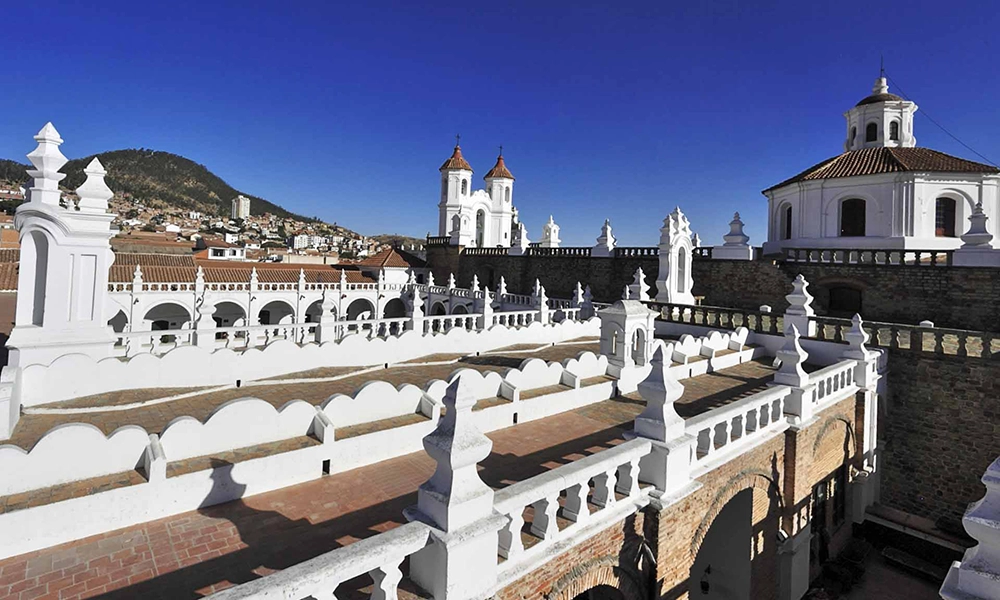
San Felipe Neri Church in Sucre: Spirituality, Education, and the White City’s Most Iconic Terraces
The San Felipe Neri Church is one of the most unique and comprehensive religious complexes in the city of Sucre. Unlike other colonial churches, this place brings together faith, history, education, and urban planning, offering one of the most memorable experiences for visitors: walking along its terraces and observing Sucre from above.
San Felipe Neri is not just a church: it is a living space that has accompanied the spiritual and intellectual evolution of the city for more than two centuries.
🕰️ Historical Context: Sucre as the Intellectual Center of Upper Peru
During the 17th and 18th centuries, the city of La Plata (now Sucre) consolidated itself as one of the most important centers of Upper Peru. Key institutions such as the Royal Audiencia of Charcas, universities, seminaries, and religious houses were concentrated here.
In this context, the Temple of Saint Philip Neri emerged, its construction taking place in the 18th century, a period marked by the city’s educational and religious flourishing. The complex was designed to address two fundamental needs:
- Spiritual formation
- Moral and intellectual education of young people
This dual purpose profoundly shaped the temple’s identity.
✝️ Saint Philip Neri: the saint of joy and education
The temple is dedicated to Saint Philip Neri, a 16th-century Italian priest known for his approachable, joyful, and deeply human spirituality. Unlike other, more rigid religious models, Saint Philip Neri promoted:
- Faith lived with joy
- Dialogue and community
- Education as a spiritual path
- The accompaniment of young people
This spirit directly influenced the temple’s mission in Sucre, transforming it into a space open to the community and to learning.
🏗️ Colonial Architecture: Sobriety and Harmony
- ⛪ The Façade
The façade of the Church of San Felipe Neri is an example of sober colonial architecture, perfectly integrated into the urban landscape of Sucre. Its white walls, simple lines, and balanced proportions reflect the values of austerity and order characteristic of the late colonial period.
It does not seek to impose itself through excessive ornamentation, but rather through its harmony with the surroundings and its understated elegance.
- 🕍 The Interior
The interior of the church maintains an atmosphere of profound contemplation:
- Spacious and luminous nave
- Moderate decoration
- Simple altars
- Intelligent use of natural light
Everything is designed to foster contemplation and spiritual concentration, without unnecessary distractions.
🎓 San Felipe Neri as an Educational Space
One of the most important aspects of the complex is its educational role. During the colonial period and the early years of the Republic, San Felipe Neri was closely linked to the formation of young people, both religiously and academically.
Its facilities included:
- Classrooms
- Study spaces
- Community areas
This educational approach reinforces Sucre’s identity as a university city, heir to an intellectual tradition that remains vibrant today.
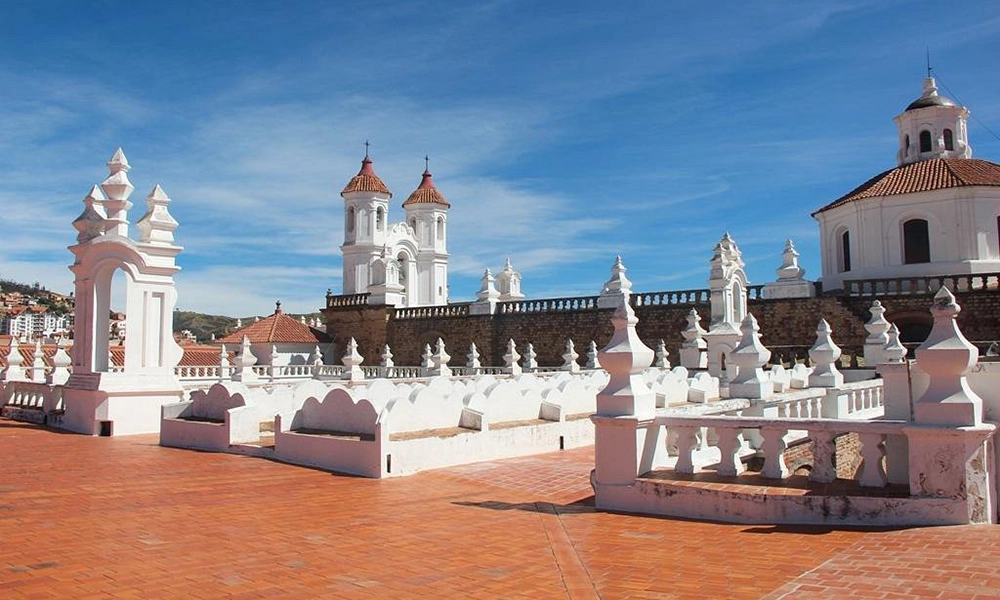
🌆 The Terraces of San Felipe Neri: A Unique Experience
Without a doubt, the most famous feature of the temple is its accessible terraces, an exceptional element within colonial religious architecture.
🌄 What can you see from the terraces?
From the top, you can appreciate:
- The historic center of Sucre
- White rooftops and colonial streets
- Iconic domes and churches
- The orderly urban layout
Walking through these terraces is a unique experience: you’ll traverse elevated walkways, archways, and viewpoints that allow you to observe the city from a different, almost intimate perspective.
🌅 The Best Time
Sunset is the preferred time for visitors and photographers, when the warm light highlights the white tones of the city and creates one of the most beautiful cityscapes in Bolivia.
🏛️ Urban and Symbolic Importance
The Temple of San Felipe Neri fulfills several fundamental roles in the city:
- ⛪ Religious: an active space for worship
- 🎓 Educational: a formative legacy
- 🏙️ Urban: an architectural landmark of the historic center
- 🌄 Landscape: a privileged viewpoint
Its strategic location allows us to understand the colonial structure of Sucre, a city designed for order, community life, and restrained monumentality.
🌎 Heritage Value
The temple is part of the historic ensemble of Sucre, a city recognized as a World Heritage Site by UNESCO. Its preservation is key to maintaining the architectural and cultural identity of the White City.
San Felipe Neri represents a particular way of understanding religious architecture: spiritual, educational, and profoundly urban.
🧭 Practical Visit
Visitor Tips:
- 🕰️ Visit in the morning or at sunset
- 👟 Wear comfortable shoes for the terraces
- 📷 Ideal for panoramic photography
- 🤫 Please be respectful inside the church
The complete visit (church + terraces) usually takes between 45 minutes and 1 hour.
The Church of San Felipe Neri is one of the places where Sucre reveals itself in all its complexity. It is a church, a school, a viewpoint, and an urban symbol all at once. Its terraces allow you to walk on history, while its interior invites silence and reflection.
Visiting San Felipe Neri is to understand Sucre from above and from within, exploring a space where faith, knowledge, and the city come together in a unique way.
❓ Expanded FAQs about the Temple of San Felipe Neri
📍 Where is the Temple of San Felipe Neri located?
The Temple of San Felipe Neri is located in the historic center of Sucre, a few blocks from Plaza 25 de Mayo. Its strategic location makes it an ideal stop on any tour of the White City.
🕰️ When was the temple built?
The temple was built during the 18th century, at the height of the colonial era, when Sucre (then La Plata) was one of the main religious, legal, and educational centers of Upper Peru.
✝️ To which religious order did Saint Philip Neri belong?
The temple was linked to the Congregation of the Oratory of Saint Philip Neri, a religious community dedicated to spiritual and educational formation, especially for young people.
👤 Who was Saint Philip Neri?
Saint Philip Neri was a 16th-century Italian priest, known as the “saint of joy.” He promoted a spirituality of closeness, based on dialogue, education, and community—values that directly influenced the mission of the church in Sucre.
🏗️ What architectural style does the church have?
The Church of Saint Philip Neri features a sober colonial style, characteristic of Sucre:
- Simple facade
- Balanced proportions
- Moderate decoration
- Predominance of the color white
This style seeks harmony with the urban environment rather than ostentation.
⛪ Does the church still function as a church?
Yes. The Church of Saint Philip Neri is an active religious space, where liturgical celebrations and pastoral activities take place, in addition to receiving visitors.
🌆 Why are the terraces of Saint Philip Neri so famous?
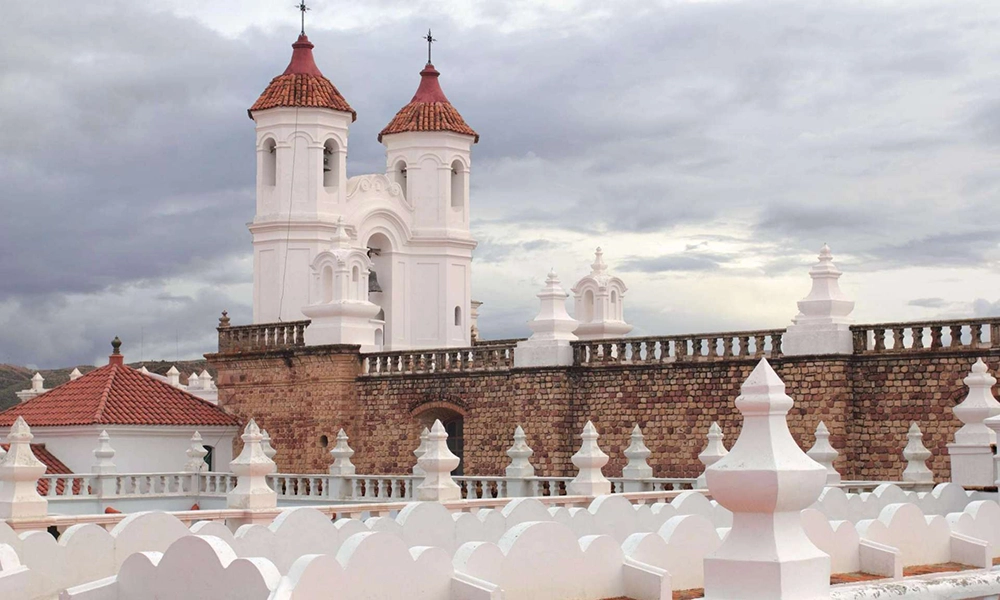
The terraces are famous because they allow you to walk on the colonial roofs and get one of the best panoramic views of the historic center of Sucre, something uncommon in colonial churches.