

Cretaceous Park of Sucre, Bolivia: A Journey to the Past When Dinosaurs Roamed the Plains
The Cretaceous Park is one of the country’s most impressive scientific, educational, and tourist attractions. It’s not just a theme park with dinosaur sculptures, but a paleontological site of global significance, home to one of the largest collections of fossilized dinosaur footprints ever discovered: the famous Cal Orck’o.
Visiting the Cretaceous Park is like walking through millions of years of natural history and understanding that, long before the white city of Sucre, this region was a vast swampy landscape roamed by prehistoric giants.
🌍 A Unique Discovery in the World
What makes the Cretaceous Park truly extraordinary is the Cal Orck’o cliff, a gigantic limestone wall where thousands of dinosaur footprints (ichnites) are found. These footprints belong to different species and periods of the Late Cretaceous, when dinosaurs ruled the planet.
What’s surprising is their almost vertical arrangement. Originally, the footprints were in a horizontal muddy ground. However, due to tectonic movements that occurred over millions of years, the ground rose until it was almost upright, like a natural wall that now allows the footprints to be seen clearly.
This phenomenon makes Cal Orck’o a unique natural archive, comparable to the most important paleontological sites in the world.
🧠 Why are footprints so important?
Unlike bone fossils, footprints allow scientists to study dinosaur behavior, not just their physical form. From the ichnites, it’s possible to infer:
- The approximate size and weight of the animal
- Whether it walked alone or in a group
- The direction of movement
- The walking speed
- The type of terrain it moved across
At Cal Orck’o, footprints of carnivorous and herbivorous dinosaurs have been identified, including enormous sauropods, demonstrating that this area was a rich and diverse ecosystem.
🏞️ What exactly is the Cretaceous Park?
The Cretaceous Park is a tourist and educational complex created to protect, interpret, and disseminate the scientific value of Cal Orck’o. It is located on the outskirts of Sucre and is managed in coordination with local institutions.
The park fulfills three main functions:
- Protection of the paleontological site
- Scientific and cultural education
- Family and educational tourism
Thanks to this combination, the park is visited by scientists and students, as well as families and tourists.
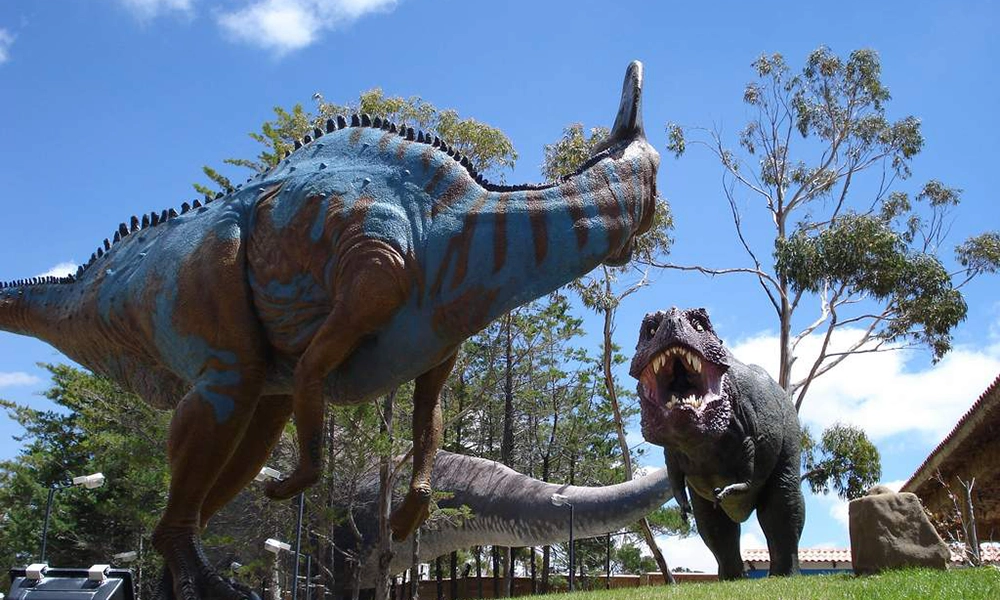
🦕 Life-size dinosaur replicas
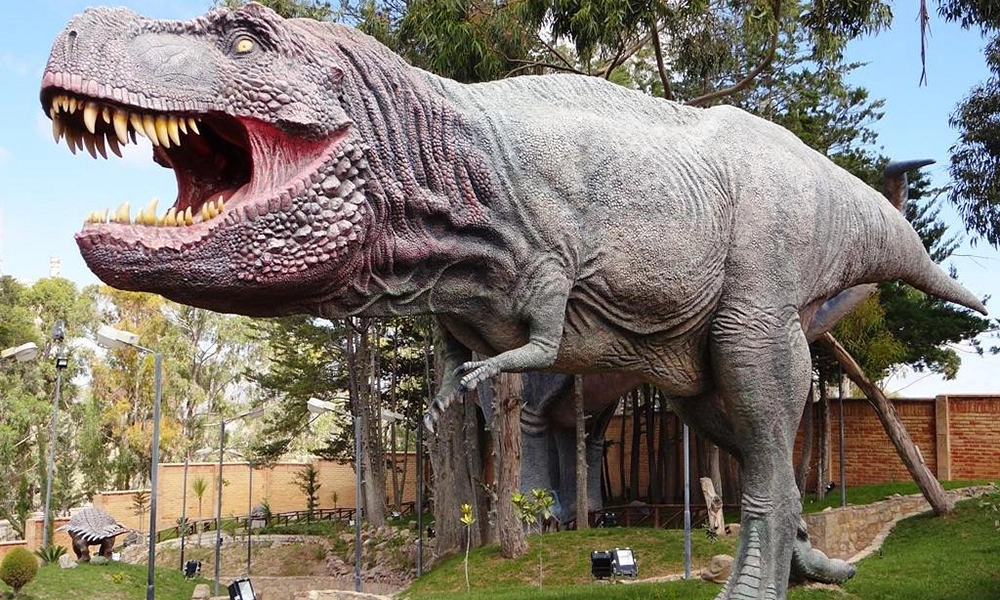
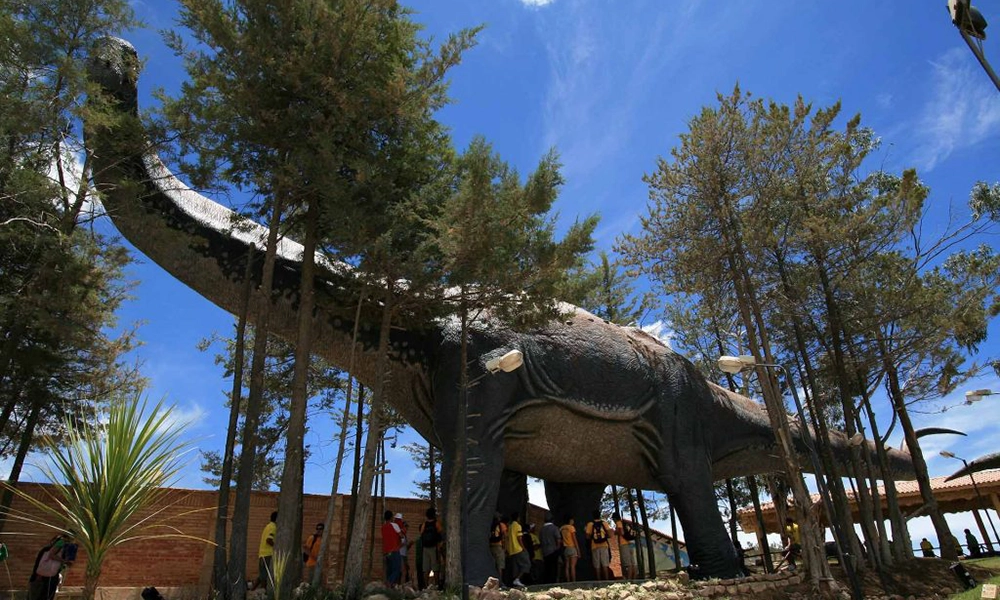
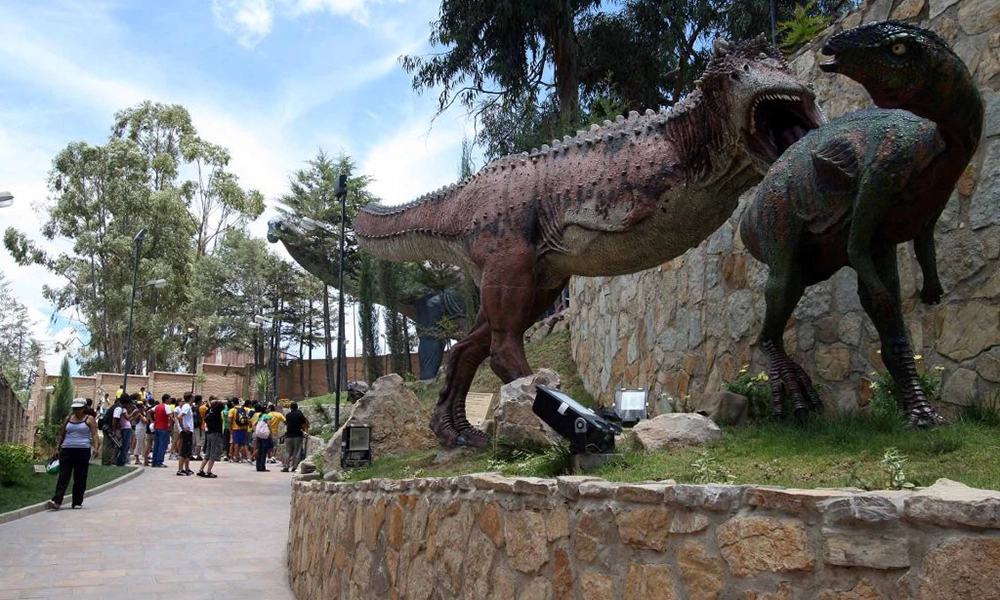
One of the most striking aspects of the park is its area of life-size dinosaur sculptures. These replicas allow visitors to visualize what the animals that left their footprints at Cal Orck’o looked like.
Among the figures you can see are:
- Large herbivorous dinosaurs
- Bipedal carnivorous dinosaurs
- Baby dinosaurs and scenes of their behavior
- Recreated environments from the Cretaceous period
These sculptures serve a fundamental educational purpose, especially for children and young people, facilitating the understanding of complex scientific concepts in a visual way.
🚌 The Tour and the “Dino Bus”
The Cretaceous Park has an organized tour system that typically includes the use of the Dino Bus, an internal shuttle that takes visitors to the most important points of the tour, especially the observation areas of the cliff.
This system allows for:
- Optimizing visit time
- Ensuring safety
- Facilitating access for people of different ages
The tour is designed to help visitors progressively understand the geological, biological, and scientific context of the site.
🌋 Geology and Landscape
In addition to its paleontological value, the Cretaceous Park is an ideal place to understand the geological history of the Andean region. The uplift of the Cal Orck’o cliff is clear evidence of the tectonic processes that shaped the Andes Mountains.
From the park, you can observe a semi-arid landscape, with contrasts between rock, sky, and sparse vegetation, which reinforces the feeling of being in a timeless setting.
🎓 An Open-Air Classroom
The Cretaceous Park functions as an open-air educational space. It is regularly visited by:
- Schools
- Colleges
- Universities
- Researchers
Here, knowledge from the following fields is integrated:
- Paleontology
- Geology
- Biology
- Natural History
- Heritage Conservation
This makes it one of the most important educational spaces in Bolivia for the natural sciences.
⚠️ Conservation and Challenges
Cal Orck’o is an extremely valuable but also fragile site. Factors such as erosion, nearby industrial activity, and natural phenomena necessitate the implementation of conservation plans and ongoing monitoring.
For this reason, some areas may have restricted access at certain times. These measures aim to protect the footprints for future generations, prioritizing scientific value over mass access.
🧭 Tips for your visit
- 🕰️ Dedicate at least half a day
- 🧢 Bring sun protection
- 👟 Wear comfortable shoes
- 📷 Bring a camera or cell phone with a good battery
- 🧒 Ideal for family and school visits
The best time to visit is usually in the morning or mid-afternoon, when the light allows for better appreciation of the footprints.
🌎 Importance for Sucre and Bolivia
The Cretaceous Park complements Sucre’s historical and cultural heritage with a unique natural and scientific heritage. While the city showcases its colonial and republican heritage, the park serves as a reminder that the history of Bolivian territory stretches back millions of years.
It is one of the few places where you can connect:
- Natural History
- Science
- Education
- Tourism
in a single experience.
The Cretaceous Park of Sucre is much more than a tourist attraction: it is a direct testament to prehistoric life, a window into the planet’s deep past.
Walking past Cal Orck’o is to understand that before churches, plazas, and castles, this land was roamed by giants. Visiting this park is to remember that history does not begin with humankind, but with the Earth itself.
❓ Frequently Asked Questions (FAQ)
1. How long does the visit to Cretaceous Park last?
Approximately 2 to 3 hours.
2. Can I get there on my own?
Yes, you can take minibuses, taxis, or private transportation.
3. Are there guided tours?
Yes, they are included in the admission price and are offered every hour.
4. Can I visit the Farallon up close?
Yes, but only with authorized guides and depending on weather conditions.
5. Can I buy souvenirs?
Yes, there is a shop with replicas, books, T-shirts, and park souvenirs.