
The Uyuni region is world-renowned for its salt flats, but few travelers know that it also harbors one of the most fascinating concentrations of Andean fauna in South America. In this high-altitude territory, characterized by intense cold and saline soils, life has developed unique adaptations that allow it to survive in extreme conditions.
Much of this biodiversity is protected within the Eduardo Avaroa Andean Fauna National Reserve, a natural area that conserves high-altitude lakes, volcanic deserts, and pampas where birds, mammals, and microorganisms essential for the ecological balance of the Altiplano coexist.
🌍 The Andean ecosystem of Uyuni: an extreme environment
The Andean fauna of Uyuni thrives at altitudes above 4,000 meters above sea level. m., in an ecosystem characterized by:
- Extreme temperatures: from -15 °C at night to 20 °C during the day
- High solar radiation and low oxygen levels
- Volcanic, saline, and nutrient-poor soils
- Strong winds and sparse vegetation
- Lakes with high mineral concentrations
This context makes the southern Bolivian highlands a natural laboratory of biological adaptation, where each species plays a vital role.
🦩 Flamingos: the stars of Uyuni
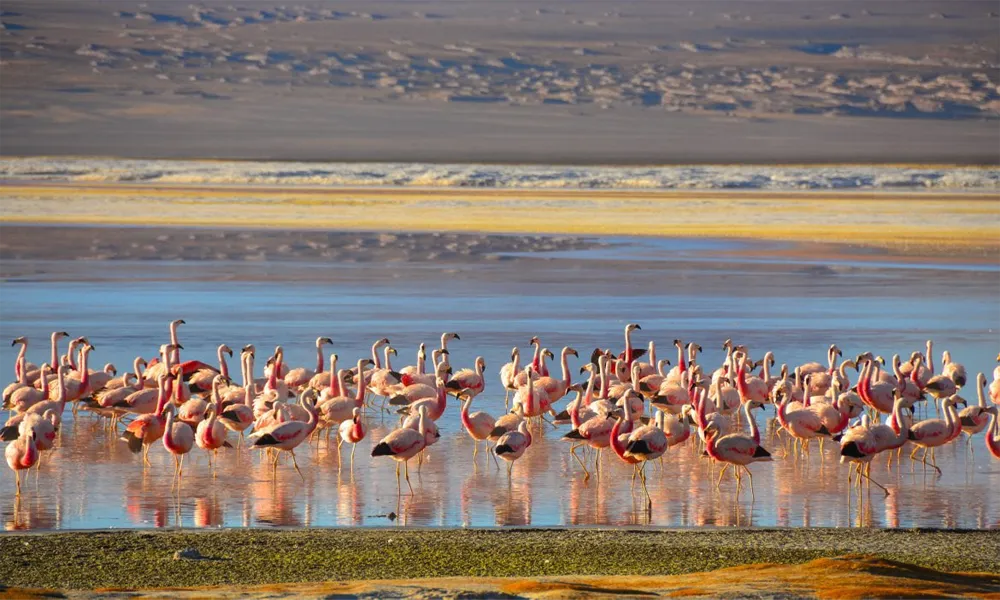
Uyuni is one of the main flamingo sanctuaries in the Andes. Its high-altitude lakes are home to three emblematic species, considered natural symbols of the highlands:
- 🦩 Andean Flamingo
Distinguished by its bright pink plumage and yellow legs. It prefers lakes rich in minerals and microorganisms.
- 🦩 Chilean Flamingo
Larger in size, with grayish legs and pink knees. It is the most adaptable species.
- 🦩 James’s Flamingo
Smaller and more delicate, it inhabits areas of very high salinity and altitude.
📍 They can be observed in lagoons such as Hedionda, Honda, Cañapa, and Colorada, feeding on microalgae and plankton, which are responsible for their coloration.
🐦 High Andean Birds: Diversity in the Altiplano Sky
In addition to flamingos, Uyuni is home to a remarkable variety of birds adapted to the high altitude:
- Andean Avocet, easily recognizable by its upturned beak
- Andean Gull, common in salt lagoons
- Puna Duck and Andean Duck, specialists in cold waters
- Andean Rhea (rhea), an endangered flightless bird
- Andean Condor, the largest flying bird in the world, visible in mountainous areas
These species have larger wings and highly efficient lungs, ideal for flying in low-oxygen environments.
🦙 Andean Mammals: Guardians of the Pampas
🦙 South American Camelids
Camelids are the true emblems of the Andean fauna of Uyuni:
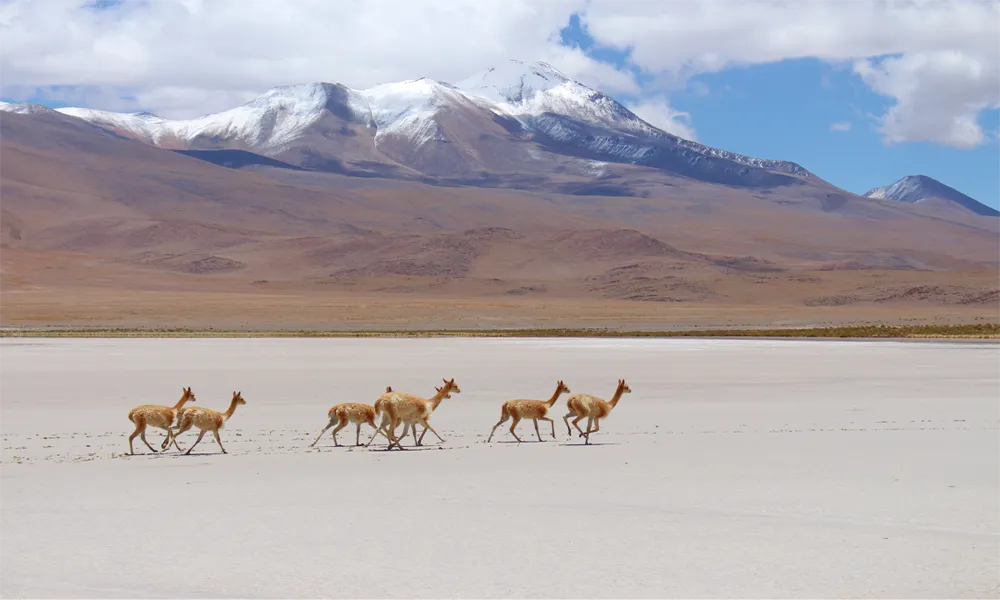
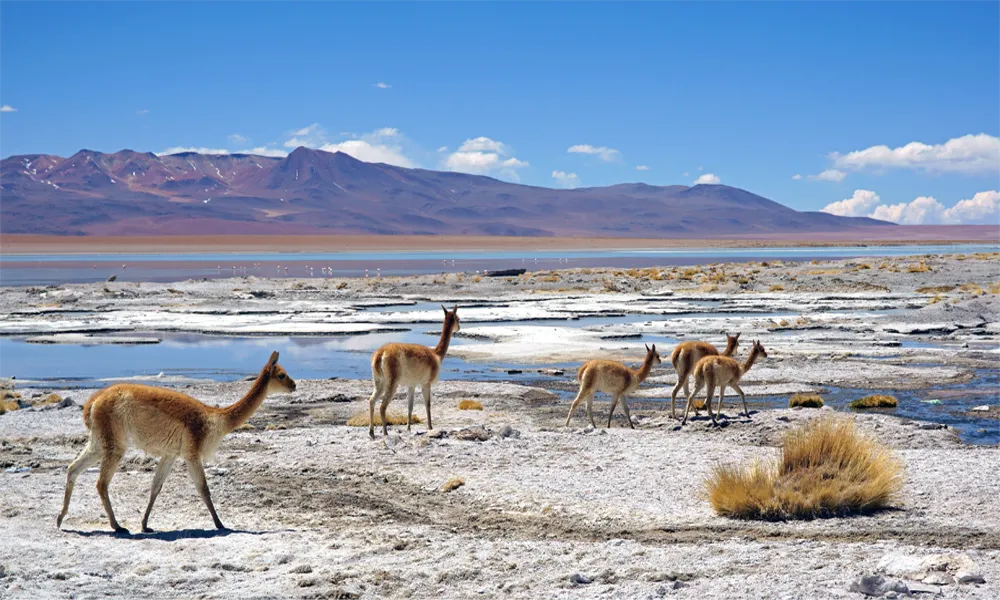
- Vicuña: wild, elegant, and protected; it possesses one of the finest wools in the world.
- Llama: domesticated since pre-Incan times, key to Andean culture.
- Alpaca: less common in Uyuni, but present in nearby areas.
These species have blood rich in hemoglobin, padded hooves, and a metabolism adapted to the cold.
🦊 Carnivores and Rodents
- Andean fox (culpeo): opportunistic and adaptable, often seen near roads
- Andean viscacha: a rodent similar to a chinchilla, inhabiting rocky areas
- Andean puma: extremely elusive and rarely seen
- Andean cat: one of the most endangered felines in South America
These animals play a fundamental role in the natural control of populations.
🐍 Reptiles, Invertebrates, and Microscopic Life
Although less visible, they are essential to the ecosystem:
- High-Andean lizards capable of withstanding nighttime frosts.
- Microscopic insects and crustaceans in salt lakes.
- Extremophile microorganisms that form the base of the food chain.
Without these organisms, species like flamingos could not survive.
🧬 Extraordinary Adaptations of Andean Fauna
The fauna of Uyuni has developed unique survival strategies:
- 🫁 Larger lung capacity
- ❤️ Blood with a high concentration of red blood cells
- 🧥 Dense, insulating fur
- 🌞 Diurnal activity to take advantage of solar heat
- 🧂 High tolerance to salinity and drought
These adaptations make Andean fauna one of the most resilient on the planet.
📸 Responsible Viewing and Conservation
To protect this fragile ecosystem, we recommend:
- 🚫 Do not feed or approach the animals
- 📷 Take photos while maintaining a distance
- 🚙 Respect established routes
- 🗑️ Do not leave any trash
- 🔇 Avoid loud noises
The conservation of Andean fauna depends largely on responsible tourism.
📅 Best time to observe wildlife in Uyuni
- ✅ April to November: dry weather, excellent visibility
- 🌧️ January to March: greater presence of water and birds, but access is variable
📌 In winter (June–August) it is intensely cold, but the skies are usually clear.
❓ Frequently Asked Questions
- Is it easy to see animals during the tour?
Yes, especially flamingos, vicuñas, and Andean birds.
- Are the animals wild?
Yes. Most live completely in the wild.
- Can they be seen year-round?
Yes, although the number of birds varies depending on the season.