

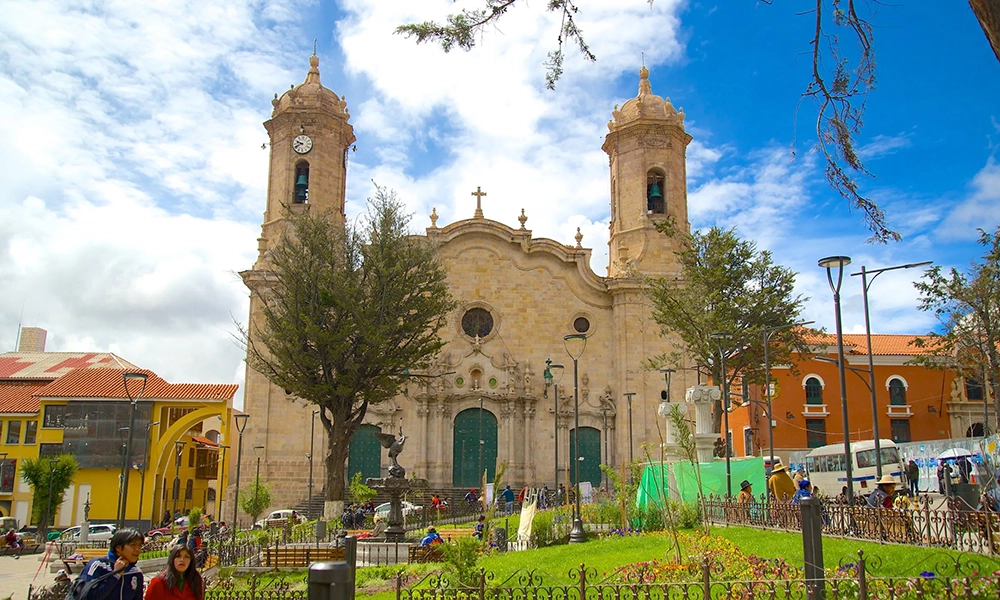
Church of San Lorenzo de Carangas
History, Art, Andean Symbolism, and a Complete Cultural Guide
The Church of San Lorenzo de Carangas is one of the most extraordinary expressions of colonial art in Bolivia and a fundamental reference point for Andean mestizo Baroque in South America. This church is not notable for its size or the ostentation of its interior, but rather for the symbolic depth and artistic complexity of its stone façade, considered a true masterpiece of viceregal sculpture.
San Lorenzo de Carangas is, above all, a book in stone: each relief, figure, and ornament narrates the encounter between the Andean indigenous world and the European Christian tradition, reinterpreted by local hands with a unique and deeply cultural language.
📍 Location and Urban Historical Context
The church is located in the historic center of Potosí, a city that during the 16th and 17th centuries was one of the most important urban centers in the world due to the silver mining of Cerro Rico. In this context of wealth, forced migrations, and cultural diversity, churches emerged for different social groups.
San Lorenzo de Carangas was conceived as a parish for the Carangas, an indigenous people from the highlands who were relocated to Potosí to work in mining and urban services. The church thus became a space for evangelization, but also a place where indigenous artisans could express their worldview.
🕰️ Origin and Historical Process of the Church
The church’s construction took place between the late 17th and early 18th centuries, during a period of great maturity in Andean colonial art. Unlike the grand churches directly commissioned by religious orders or Spanish elites, San Lorenzo was built with significant participation from indigenous and mestizo stonemasons, which explains its unique style.
Over time, the church has undergone minor modifications and restorations, but its main facade remains one of the best-preserved examples of mestizo Baroque architecture in Bolivia.
🏛️ General Architecture of the Church
From an architectural standpoint, the Church of San Lorenzo de Carangas presents a relatively simple structure:
- Rectangular floor plan
- Single nave
- Solid stone walls
- Sober roof
This structural simplicity deliberately contrasts with the decorative richness of its façade, reinforcing the idea that the church’s main message is found on the exterior, visible to the entire community.
🪨 The Baroque Portal: A Masterpiece of Mestizo Baroque
The Façade as a Stone Altarpiece
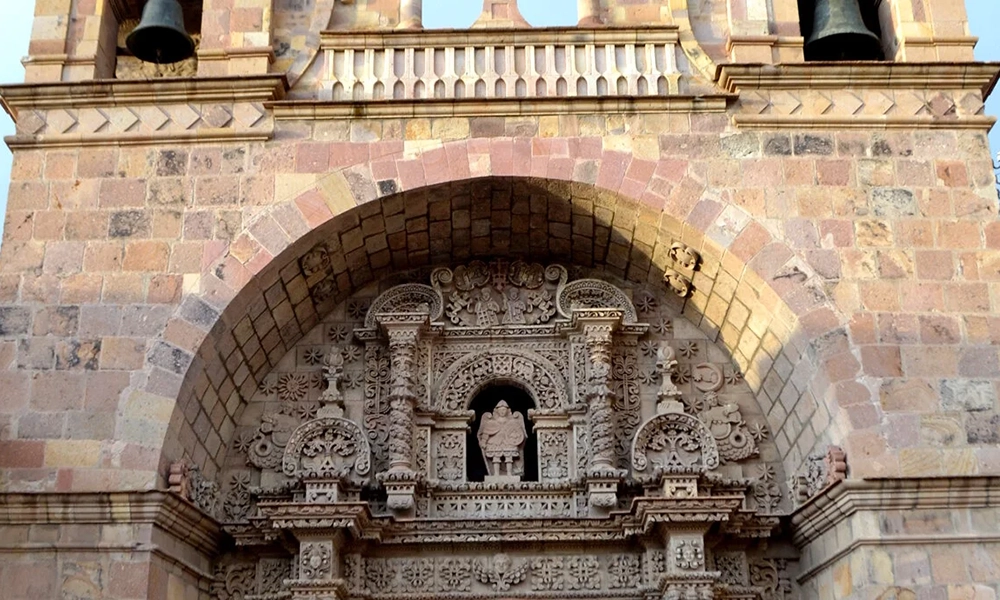
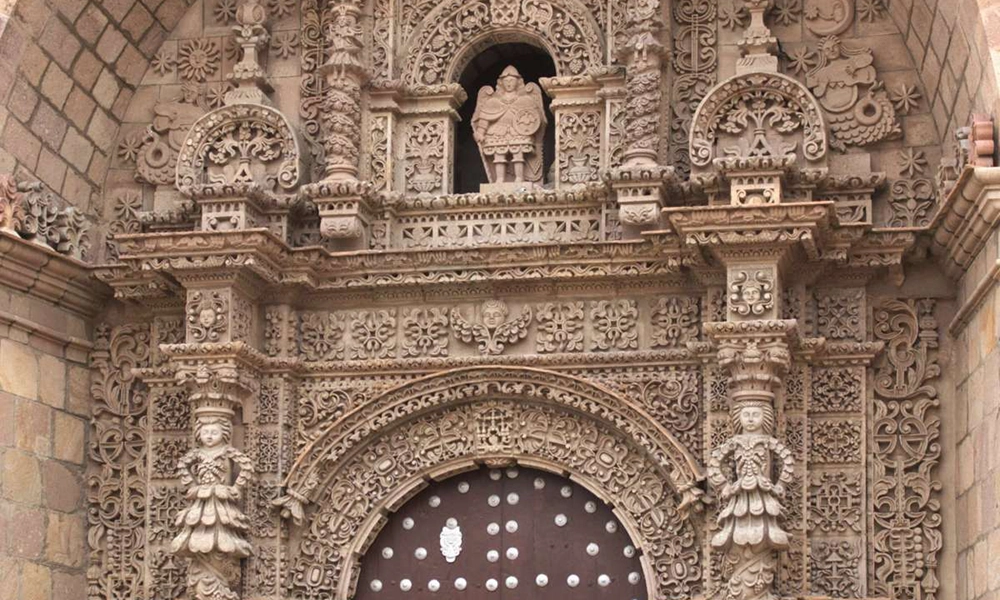
The portal of San Lorenzo de Carangas is considered one of the most complex and refined in the Andes. Carved entirely from stone, it functions as an exterior altarpiece that combines European elements with reinterpreted Andean symbols.
Key elements:
- Solomonic columns covered in vegetal reliefs
- Angels with indigenous features and local expressions
- Flowers, fruits, and leaves typical of the Andean region
- Birds, human faces, and hybrid figures
- Niches with Christian images framed by natural motifs
The composition is not chaotic: there is a symbolic order that guides the eye from the base to the top, reinforcing the spiritual message.
🌿 Andean Symbolism and Indigenous Cosmovision
One of the most fascinating aspects of San Lorenzo de Carangas is its symbolic interpretation. For the Andean peoples, nature was not merely a decorative element, but a living and sacred entity.
Common symbolic interpretations:
- The flora represents life, fertility, and abundance.
- The mestizo angels symbolize the mediation between two worlds.
- The human faces reflect the indigenous presence within Christianity.
- The movement of the forms suggests a dynamic and living universe.
This visual language allowed indigenous carvers to express their identity within an imposed framework, transforming evangelization into a process of cultural reinterpretation.
🎨 Interior of the Temple: Sobriety and Reflection
Unlike the facade, the interior of the church is austere and silent, which reinforces the impact of the exterior. Inside, the following are preserved:
- Simple colonial altarpieces
- Religious images of popular devotion
- Spaces designed for communal prayer
This difference between exterior and interior is not accidental: the facade served a pedagogical function, visually communicating the Christian message to a largely illiterate population.
⛪ Religious and Social Function
During the colonial period, San Lorenzo de Carangas was a spiritual and social center for the indigenous population of Potosí. The following took place there:
- Baptisms, marriages, and funerals
- Religious festivals and community celebrations
- Acts of social cohesion within a complex urban context
Today, the church maintains its religious character, although its cultural and heritage value is equally significant.
🏺 Artistic and Heritage Importance
The Church of San Lorenzo de Carangas is considered:
- An icon of Andean mestizo Baroque
- A key work for colonial art studies
- A tangible testament to cultural syncretism in the Andes
Its façade is frequently compared to other great expressions of Andean Baroque and is often featured in specialized catalogs of viceregal art.
👣 Visitor Experience
Visiting San Lorenzo de Carangas is an experience that requires time and observation. It is not a place to rush through.
What to do during your visit:
- Observe the facade from different angles
- Identify repeated figures and symbolic patterns
- Compare Andean features with European elements
- Take a few moments of silence inside
It’s ideal for travelers interested in history, art, anthropology, and heritage photography.
📸 Tips for an enriching visit
- Visit in the morning or mid-afternoon for better light
- Use zoom to appreciate the details
- Avoid service times if you want to observe calmly
- Read about Mestizo Baroque beforehand
- Combine your visit with other colonial churches in Potosí
❓ Frequently Asked Questions
- Why is this church so important?
Because its facade is one of the finest expressions of Mestizo Baroque in the Americas.
- Is a guide necessary?
It’s not mandatory, but a specialized guide helps interpret the symbolism.
- How long does the visit last?
Between 20 and 40 minutes, depending on your level of interest.
- Are photographs allowed?
Yes, especially of the exterior. Discretion is advised inside.
✨ A work where stone speaks
The Church of San Lorenzo de Carangas doesn’t impress with its monumentality, but with its cultural depth. Each carved figure is a voice from the past, revealing how the Andean peoples reinterpreted Christianity without losing their identity.
In a city marked by silver and sacrifice, San Lorenzo de Carangas stands as a silent testament to creativity, resilience, and cultural dialogue—an essential jewel for understanding the historical soul of Potosí.