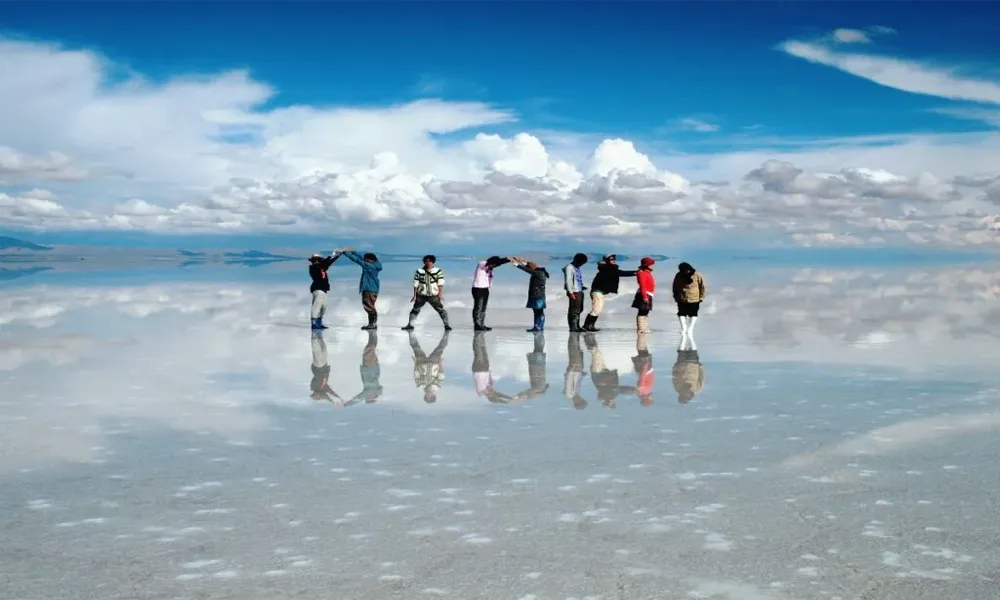

Salt Eyes of the Salar de Uyuni: Natural Mysteries in the White Desert
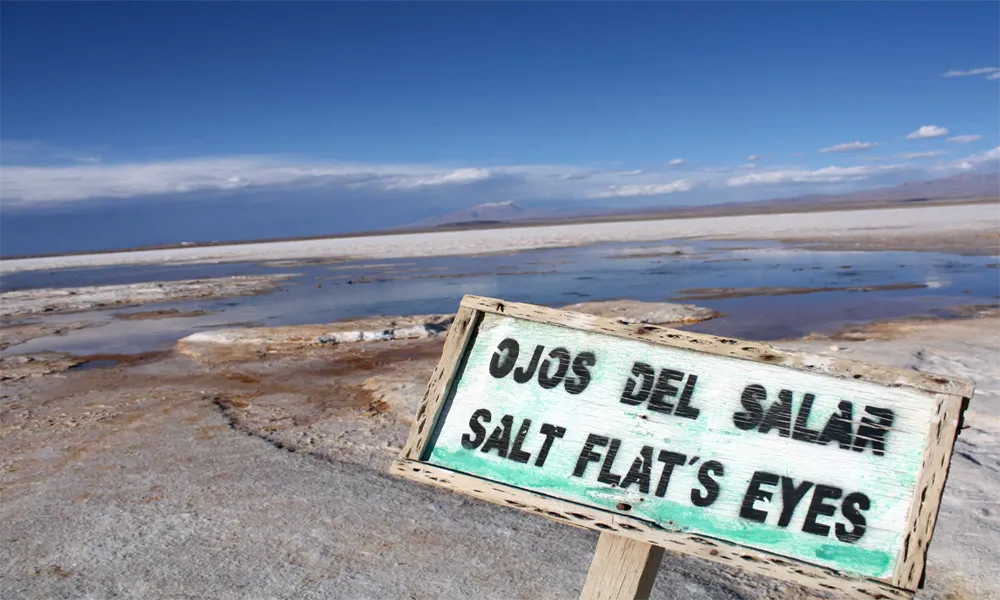
The Salt Eyes of the Salar de Uyuni are one of the most important and least known natural phenomena of the world’s largest salt flat. Although they go unnoticed by many travelers, these small pools of saline water play an essential role in the internal balance, geological stability, and “natural respiration” of the salt flat.
Far from being simple springs, the salt eyes are active conduits that connect the surface with the deeper layers of the salt flat, allowing the constant movement of water, salt, and minerals.
📍Where are the Salt Eyes of the Salar de Uyuni located?
The salt eyes are scattered throughout different areas of the Salar de Uyuni, mainly in areas far from traditional tourist routes, as they are fragile and protected zones.
- Location: Inside the Salar de Uyuni, Potosí Department – Bolivia
- Average altitude: 3,650 m above sea level
- Access: Only through specialized tours or with authorized guides
- Visit: Observation from a distance, without intervention
Many tour operators avoid stopping at these points to preserve their natural integrity.
🌋What exactly are the salt eyes?
The salt eyes are natural emanations of brine (highly saline water) that emerge from the subsoil of the salt flat to the surface. They function as release valves, allowing the internal system of the salt flat to remain in equilibrium.
Main characteristics:
- Circular or oval shape
- Dark, bluish, or greenish tones
- Constant water movement
- Crystallized salt edges
- Direct connection to deeper layers
For this reason, they are popularly called the “eyes,” “veins,” or “vents” of the Salar de Uyuni.
🧠Internal functioning: how the Salar de Uyuni “breathes”
The Salar de Uyuni is not a lifeless, solid surface; It is a dynamic system formed by layers of salt, sediments, groundwater, and minerals.
Salt springs allow for:
- The circulation of brine from deep layers
- The release of internal pressure
- The regulation of humidity levels
- The controlled evaporation of water
Without these natural drainage points, the salt flat could fracture, collapse, or lose its uniform crystalline structure.
📸 Salt springs and responsible photography
Although they are not a major visual attraction, salt springs are fascinating for:
- Documentary photography
- Educational content
- Texture and contrast details
📌 Important: They should always be photographed from a distance, without disturbing the environment.
⏰Best time to see the salt vents
- Dry season (April – November): most visible
- Mid-morning: best lighting
- Clear days: greatest color contrast
During the rainy season, many salt vents are hidden beneath the water.
🌱Responsible tourism and conservation
Visiting the Salar de Uyuni involves a great environmental responsibility.
Best practices:
- Always follow the guide
- Respect restricted areas
- Stay on the marked trails
- Do not touch or disturb the salt vents
- Choose responsible tour operators
The future of the salt flats depends on conscious and respectful tourism.
❓Frequently asked questions about the salt vents
- Are they dangerous?
No, if you maintain a safe distance. The risk arises when you disturb them.
- Are they deep?
Yes. They connect to deep layers of underground brine.
- Could they disappear?
Yes. Human intervention can cause them to collapse or dry up.
- Are they related to lithium?
Yes. They are part of the natural mineral-rich brine circulation system.