


Tiwanaku
The Cradle of an Ancient Civilization and the Great Ceremonial Center of the Andean Altiplano
Tiwanaku is one of the most important, mysterious, and transcendent archaeological complexes in South America. Located on the Bolivian Altiplano, this site was the political, religious, scientific, and cultural heart of a civilization that reached an extraordinary level of organization and knowledge long before the expansion of the Inca Empire.
Declared a World Heritage Site, Tiwanaku is not just a tourist destination: it is a fundamental key to understanding the origin of the Andean worldview, the sacred relationship with nature, and pre-Hispanic technological advancements under extreme altitude conditions.
📍 Geographic Location and Natural Environment
Tiwanaku is located in the department of La Paz, Bolivia, approximately 72 km west of the city of La Paz, very close to Lake Titicaca, a vital source of water, spirituality, and resources for the cultures of the Altiplano.
Key Geographic Data:
- Altitude: 3,850 m (12,500 ft)
- Region: Andean Altiplano
- Climate: Cold and dry
- Landscape: High plains, agricultural fields, and distant mountains
This strategic location allowed Tiwanaku to develop as a center of power that controlled trade and cultural routes across much of the central Andes.
🕰️ History of the Tiwanaku Civilization
The Tiwanaku civilization flourished approximately between 400 and 1100 CE, although some studies suggest earlier occupations. During its height, Tiwanaku was one of the most influential societies on the continent.
Characteristics of the civilization:
- Complex state organization
- Religion deeply linked to natural cycles
- Broad cultural influence (Peru, northern Chile, southern Bolivia, and Argentina)
- Mastery of agricultural and hydraulic engineering
Unlike other pre-Hispanic centers, Tiwanaku did not expand primarily through warfare, but rather through religious, economic, and symbolic influence.
🌾 Advanced agriculture: the suka kollus
One of Tiwanaku’s greatest achievements was the development of raised agricultural fields, or suka kollus, a system that allowed cultivation in flood-prone and cold areas.
Advantages of the system:
- Protection against frost
- Humidity control
- Improved agricultural productivity
- Long-term sustainability
This system demonstrates the Tiwanaku people’s profound environmental knowledge and their ability to adapt to the high plateau.
🧘 Andean Cosmovision and Spirituality
For Tiwanaku, the world was not divided into the human and the natural. Everything was part of a cosmic order where the Sun, the Moon, water, and earth were living entities.
The site functioned as:
- A ceremonial center
- An astronomical observatory
- A place for fertility and renewal rituals
- A space connecting the earthly world and the sacred world
Many of these concepts were inherited and reinterpreted by the Incas centuries later.
🧱 Monumental Architecture of Tiwanaku
Tiwanaku’s architecture stands out for its precision, symbolism, and durability, achieved without the use of metal tools or wheels.
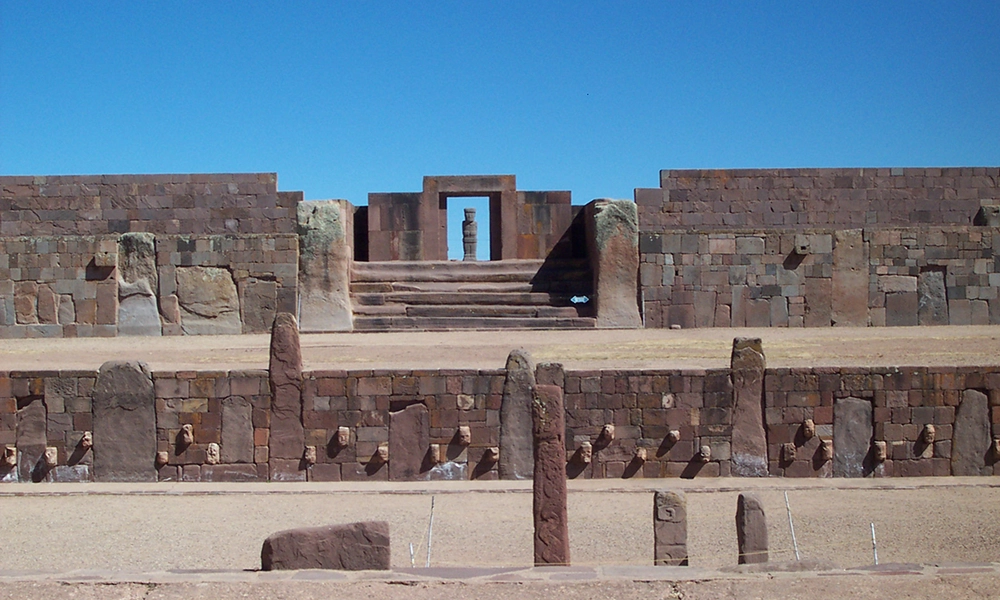
🏛️ Kalasasaya: The Temple of the Sky
A large ceremonial platform used as an astronomical observatory. From here, the following were marked:
- Solstices
- Equinoxes
- Agricultural cycles
The alignment of its walls demonstrates an advanced understanding of solar movement.
🚪 Gate of the Sun: symbol of the Andean world
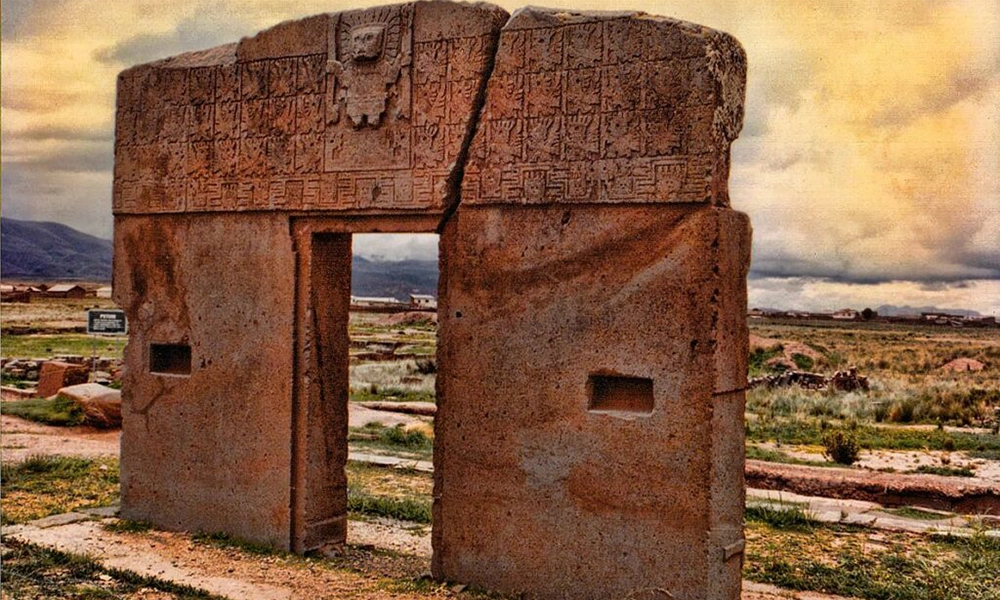
Carved from a single block of andesite, the Gate of the Sun depicts the god Wiracocha, surrounded by winged figures and calendrical symbols.
It is believed that it:
- Represents a ritual calendar
- Marks cycles of time and the cosmos
- Symbolizes universal order
Is one of the most important stone artifacts of pre-Columbian America.
🗿 Semi-subterranean Temple: the world of the ancestors
This sunken enclosure is decorated with tenon heads embedded in the walls.
Possible Interpretations:
- Representation of peoples integrated into the state
- Deified ancestors
- Altered states of ritual consciousness
Its design suggests a ceremonial space of great symbolic significance.
⛰️ Akapana Pyramid: Water and Power
A stepped structure with sophisticated hydraulic channels, associated with the worship of water, rain, and fertility.
Akapana symbolizes:
- The sacred mountain
- Control of water
- The balance between nature and society
🧩 Puma Punku: Engineering Out of Time
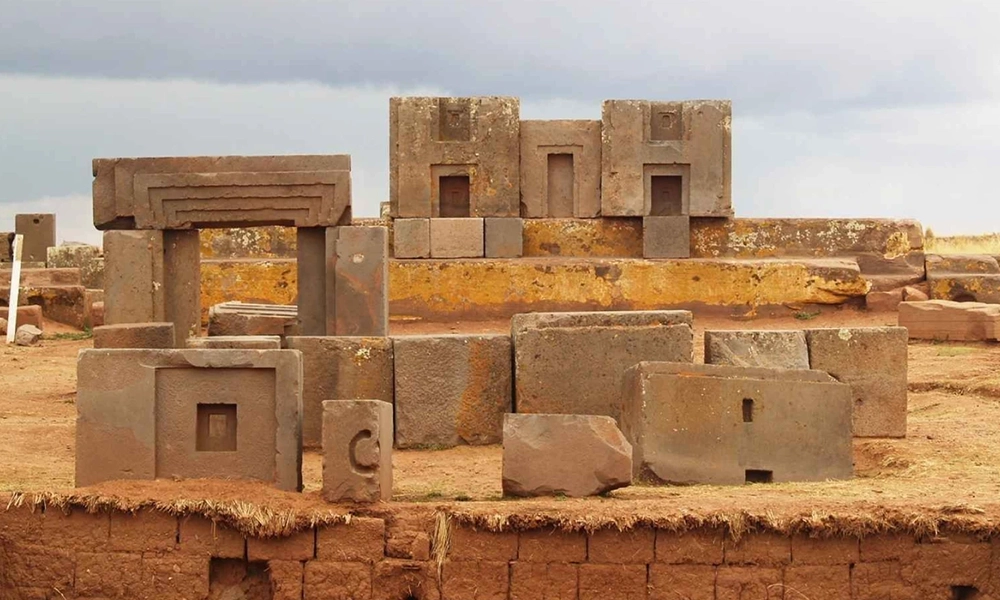
Perhaps the most enigmatic sector of Tiwanaku. Puma Punku features stone blocks carved with astonishing precision, some shaped like an “H,” assembled like a jigsaw puzzle.
Highlights:
- Precise cuts
- Perfect joints
- Use of metal staples
- Technology still debated by researchers
Puma Punku challenges many traditional ideas about ancient engineering.
🌱 Flora of the Tiwanaku area
The flora reflects adaptation to the high-altitude climate.
Common species:
- Ichu (Andean straw)
- Native grasses
- Traditional medicinal plants
- Cold- and Dry-Resistant Vegetation
🦙 High Plateau Fauna
In the surrounding area, you can observe:
- Llamas and alpacas
- Vicuñas (nearby areas)
- High Andean birds
- Andean foxes (occasionally)
🌦️ Climate in Tiwanaku
The climate is cold and dry, with a large temperature range.
Temperatures:
- Daytime: 10°C to 18°C
- Nighttime: -5°C to 3°C
High solar radiation during the day and frequent winds.
📅 Best Time to Visit
✅ Dry Season (April to October)
- More stable weather
- Clear skies
- Best archaeological experience
👉 Ideal months: May to September
🚍 How to get to Tiwanaku
From La Paz:
- 🚌 Public bus (approx. 2 hours)
- 🚗 Private vehicle
- 🚐 Organized tour (half-day or full-day)
🧭 Tourist activities
- Specialized guided tours
- Visits to archaeological museums
- Cultural photography
- Historical and educational tourism
- Symbolic astronomical observation
💰 Approximate prices
- Entrance fee for foreigners: approx. Bs. 100
- Tours from La Paz: USD 20–60
❓ Frequently Asked Questions (FAQs)
How much time is needed to visit Tiwanaku?
Between 3 and 4 hours with a guide.
Is it recommended to go with a guide?
Yes, to understand the symbolic meaning of the site.
Is it suitable for children and seniors?
Yes, walking slowly due to the altitude.
Are there museums at the complex?
Yes, with original artifacts and historical explanations.
✅ Final Recommendations
- Warm clothing in layers
- Sunscreen and a hat
- Stay hydrated
- Walk slowly
- Respect archaeological structures
✨ Why is Tiwanaku a must-see?
Because it is one of the most influential ceremonial centers in the Americas, key to understanding Andean thought, pre-Hispanic engineering, and the cultural heritage that gave rise to later civilizations.
Tiwanaku is not just an archaeological site: it is a living legacy that connects the past with the Andean present. Visiting it is to delve into a civilization that understood time, nature, and the cosmos in a profoundly advanced way.